THE STORY
Contents
- Gunnuhver, Iceland: A Stolen Pot, a Sorcerer's Thread, and the Steam Beneath the Ground
- Quick Facts: Gunnuhver & the Reykjanes Geothermal Field
- A Sorcerer-Pastor's Knot: Why Only a Ball of Wool Could Hold Guðrún Önundardóttir
- Down Borehole RN-10: The 320°C Seawater Furnace Beneath the Clay
- Earthquakes in 1967, Turbines in 2006: How Pressure Drawdown Woke the Steam Cap
- Walking the Crust Between Valahnúkamöl and the Acid Plume
- Frequently Asked Questions (FAQ): Visiting Gunnuhver
- Can you swim or bathe in Gunnuhver like the Blue Lagoon?
- Who was Gunna in the Gunnuhver ghost story?
- Why is Gunnuhver's deep reservoir seawater-fed?
- Why did steaming at Gunnuhver intensify after 2006?
- Related Iceland Explained Episodes
Gunnuhver, Iceland: A Stolen Pot, a Sorcerer's Thread, and the Steam Beneath the Ground
Companion piece to the video episode: Gunnuhver & the Reykjanes Terminal Rift
In May 2006, when engineers at the newly commissioned Reykjanes Geothermal Power Plant (Reykjanesvirkjun, 63.8242, -22.6795) opened the main valves on their deep production wells and began pulling roughly 800 kilograms of superheated brine per second out of the volcanic crust at the southwestern tip of the Reykjanes Peninsula, standard textbook intuition suggested that the nearby mud pots at Gunnuhver (63.8190, -22.6852) might lose pressure and quiet down (World Geothermal Congress: Response of the Reykjanes Geothermal System; Visit Reykjanes: Gunnuhver).
Instead, the ground heated up, boiled harder, and breathed a thicker wall of acid steam across the footpaths (Visit Reykjanes).
Anyone raised on the folklore of Suðurnes could have told the engineers that taking something out of this corner of the peninsula without settling the bill always makes the ground angrier. Three hundred years before a drill bit ever pierced the rock at Reykjanes, a powerful Law Council member named Vilhjálmur Jónsson rode over to the northern farmstead of Kirkjuból in Miðnes (64.0530, -22.7050) and confiscated the single iron cooking pot owned by an elderly pauper tenant named Guðrún Önundardóttir (Visit Reykjanes: The Story Behind Gunnuhver; Amazing Iceland: Gunnuhver). In the local legend, the consequences of that seizure would eventually lead all the way to the boiling ground at Gunnuhver. Centuries later, instruments in a deep well would reveal another story beneath the clay: salt water, heat and a reservoir whose pressure could change the face of the field.
Quick Facts: Gunnuhver & the Reykjanes Geothermal Field
| Attribute | Verified Field Data |
|---|---|
| Canonical Name & Etymology | Gunnuhver (/ˈkʏtnʏˌkʰvɛːr/, "Gunna's Hot Spring"), named after Guðrún ("Gunna") Önundardóttir, an early 18th-century pauper tenant at Kirkjuból (Amazing Iceland: Gunnuhver). |
| Coordinates & Dimensions | Main Mud Cauldron: 63.8190, -22.6852 (~18 m a.s.l., ~20 m crater diameter) | Kísilhóll Sinter Dome: 63.8198, -22.6835 | Borehole RN-10 / Power Plant: 63.8242, -22.6795. |
| Deep vs. Surface Hydro-Thermal System | Seawater-fed deep geothermal reservoir exceeding 300°C (572°F; Well RN-10 drilled to 2,054 m logged up to ~320°C); ascending steam condenses and mixes with shallow surface water to form acid mud boiling at ~100°C (Stanford Geothermal Workshop: Well RN-10; Visit Reykjanes). |
| Chemical Weathering | Ascending H2S steam oxidizes in shallow aerated water into sulfuric acid (H2SO4), leaching cations from solid basaltic lava and reducing the rock into boiling gray-blue clay bordered by red iron oxides and yellow sulfur rims. |
| Surrounding Lava Units | Stampar crater rows (1210–1240 AD Reykjaneseldar) & Háleyjabunga (~9,000 BP primitive mantle picrite shield) (Guide to Iceland: Stampar; Visit Reykjanes: Geosites). |
| 1967 & 2006 Thermal Surges | Surface steaming surged after a September 1967 earthquake swarm and again after the May 2006 startup of the 100 MWe Reykjanes Power Plant, when reservoir pressure at 1,500 m below sea level dropped from ~120 bar-g to ~95 bar-g and expanded the underground steam cap (World Geothermal Congress 2010; Geophysical Journal International). |
| Biological & Coastal Context | Heat-adapted microbes (including Thermus isolates) and invasive Southern Hemisphere star moss (Campylopus introflexus) studied in Icelandic geothermal habitats (PubMed; Skemman); flanked on the coast by the storm-boulder ridge of Valahnúkamöl (63.8130, -22.7160). |
A Sorcerer-Pastor's Knot: Why Only a Ball of Wool Could Hold Guðrún Önundardóttir
Start not at the mud pit, but eighty kilometers east along the south coast at the turf parsonage of Vogsósar in Selvogur (63.8510, -21.6930), where the Lutheran pastor Séra Eiríkur Magnússon lived and preached from 1667 until his death in 1716 (Wikipedia: Eiríkur í Vogsósum).
If you only hear the tourist version of the Gunnuhver legend, that a priest gave villagers a magic ball of wool yarn (hnypill) that rolled across the lava and tricked a ghost into falling into a boiling spring, the story sounds like a charming bit of rural superstition (Visit Reykjanes: The Story Behind Gunnuhver). Look closer at who Séra Eiríkur was, and at how seventeenth- and eighteenth-century Icelanders understood the undead, and the yarn ceases to be a fairy-tale prop. Educated at the Skálholt cathedral school, Eiríkur belonged to that distinctly Icelandic breed of clerical intellectuals known as kraftaskáld ("power-poets") and white magicians: men who preached orthodox Lutheran sermons on Sunday morning and were whispered to consult the forbidden grimoire Gráskinna ("Grey-Skin") on Monday night when a parishioner's sheep vanished or a corpse refused to stay in the churchyard (Wikipedia).
According to the tradition, the answer Eiríkur sent west was a ball of wool. The loose end would find its way into the hands of Guðrún Önundardóttir, or Gunna; the ball would lead her to a hot spring on Reykjanes. It is an oddly domestic piece of equipment for dealing with the dead: no iron chain, no elaborate machinery, just a length of thread and the expectation that she would follow it (Visit Reykjanes; Amazing Iceland).
The story's other piece of household equipment was considerably harder to replace. Gunna lived as a poor tenant at Kirkjuból in Miðnes, where Vilhjálmur Jónsson, a local farmer and member of the Law Council (lögréttumaður), took her iron cooking pot against unpaid rent (Visit Reykjanes; Amazing Iceland). On a peninsula where imported metal was valuable, a pot belonged to the practical architecture of survival: it stood between a household and the problem of turning its food into a meal. The object at the beginning of this haunting was neither a cursed crown nor a stolen treasure. It was something a woman needed at her hearth.
In the legend Gunna died after refusing food, and the dispute did not end with her burial. Jón Árnason's recorded version gives her a voice at the grave: “Ekki þarf djúpt að grafa, ekki á lengi að liggja”: no need to dig deep, she would not lie there long. Vilhjálmur was found dead, and his widow died soon afterwards; the haunting spread across the peninsula. Those details belong to a ghost story, but the object at its centre gives the violence an uncomfortable human weight: a dispute over an ordinary possession has become a tale large enough to occupy an entire landscape.
The yarn offers a striking inversion. Ariadne's thread in Greek myth helps a man find his way out of a labyrinth; in this Icelandic tale, a thread leads the dead toward a boiling spring (Amazing Iceland; Atlas Obscura). One way to read the contrast between the stolen pot and the wool is as a story about possession: the loss of one humble object sets events in motion, while another becomes the means of ending the haunting. That is an interpretation, not an explanation the legend itself needs to state. Eiríkur's thread is strange enough on its own, and the hot ground gives the story a place where it can remain.
Down Borehole RN-10: The 320°C Seawater Furnace Beneath the Clay
Why did folk memory choose this specific vent at the southwestern tip of Reykjanes as the only prison hot enough and loud enough to hold Gunna? Because the plumbing beneath 63.8190, -22.6852 runs on a different fluid than the famous inland geysers of the Golden Circle.
Walk around Haukadalur at Geysir and Strokkur, and you are looking at highland rainwater heated by deep rock. Stand at the railing of Gunnuhver, and you are standing directly where the submarine Mid-Atlantic Ridge (the Reykjanes Ridge) breaches the North Atlantic surface across an active tectonic graben pulling apart at roughly two centimeters a year (Visit Reykjanes: Geosites). To your south rises the low, 9,000-year-old lava shield of Háleyjabunga (63.8135, -22.6710), formed from primitive, magnesium-rich picrite magma that shot straight up from the Earth's mantle without lingering in a shallow crustal chamber (Visit Reykjanes). To your west and north run the dark scoria cones of Stampar (63.8260, -22.7010), where the peninsula unzipped during the thirteenth-century Reykjanes Fires (1210–1240 AD) (Guide to Iceland: Stampar Crater Row).
Beneath those surface lavas lies a shattered, highly permeable basement of Pleistocene pillow basalts (bólstraberg) and glassy subglacial hyaloclastite breccias (móberg). Because the faults here open directly to the sea floor, the deep geothermal reservoir beneath Gunnuhver is seawater-fed (Visit Reykjanes: Gunnuhver; Iceland Travel: Gunnuhver).
We do not have to guess what happens to that ocean water two kilometers beneath your boots, because geologists led by Hjalti Franzson analyzed the drill cuttings from Borehole RN-10, a production well sunk 2,054 meters into the Reykjanes field right beside the vents (Stanford Geothermal Workshop: Well RN-10). The mineral zones logged down RN-10 read like a thermometer carved into stone: in the upper few hundred meters, warm fluids alter the basalt into soft, swelling smectite and zeolite clays; deeper down, as temperatures climb past 230°C, the rock hardens into green chlorite and epidote; and at the bottom of the borehole, where the drill bit logged a maximum temperature of about 320°C (608°F), the oceanic basalt is actively cooking into actinolite (Stanford Geothermal Workshop).
What you see churning in the twenty-meter crater of Gunnuhver is not that deep 320°C seawater pouring directly out of a pipe, and it is not ordinary dirt mixed with rain. As the superheated deep brine boils along ascending fault lines, steam separates from the heavy liquid phase and races upward carrying volatile gases, above all carbon dioxide (CO2) and hydrogen sulfide (H2S) (World Geothermal Congress 2010). Near the surface, that rising steam condenses and mixes with shallow water (Visit Reykjanes), where atmospheric oxygen converts the H2S into sulfuric acid (H2SO4). The acid attacks the solid black basalt walls from the inside out, stripping away soluble calcium, magnesium, and sodium until the hard volcanic rock collapses into a boiling, ~100°C (212°F) gray-blue clay slurry, framed by blood-red oxidized iron banks, vivid yellow sulfur needles around the fumarole throats, and the hard white silica sinter cap of Kísilhóll ("Silica Hill", 63.8198, -22.6835) (Volcanic Springs: Kísilhóll Group).
Earthquakes in 1967, Turbines in 2006: How Pressure Drawdown Woke the Steam Cap
Visitors standing on the wooden viewing decks often assume that Gunnuhver has been roaring at this exact volume since Séra Eiríkur's yarn tumbled into the pit. In reality, the hydrothermal monster you hear today has been jolted awake twice in living memory, once by the Mid-Atlantic Ridge, and once by the national power grid (World Geothermal Congress 2010: Response of the Reykjanes Geothermal System).
In September 1967, a violent tectonic earthquake swarm shook the southwestern tip of Reykjanes, cracking open sealed subterranean conduits and triggering a sudden, dramatic surge in surface boiling across the field, reactivating Gunnuhver so forcefully that for years afterward it erupted muddy water several meters into the air every few minutes (World Geothermal Congress 2010; Jökull: Geothermal Activity in Iceland). Over the following decades, as silica and clay gradually self-sealed the shallower cracks, parts of the surface field settled into a steadier simmer, surveyed in detail by geoscientists from ÍSOR (Iceland GeoSurvey) and HS Orka in 2004 (World Geothermal Congress 2010).
Then came May 2006, when HS Orka commissioned the 100 MWe Reykjanes Geothermal Power Plant (Reykjanesvirkjun) just eight hundred meters northeast of the mud pool (later expanded to 130 MW) and increased deep fluid extraction to roughly 800 kilograms per second (World Geothermal Congress 2010).
In downhole pressure logs recorded at 1,500 meters below sea level in wells RN-8, RN-9, and RN-12, the reservoir pressure before May 2006 had held rock-steady between 118 and 123 bar-g (World Geothermal Congress 2010). Within twelve months of the power plant switching on, pressure at 1,500 meters below sea level plunged to ~95 bar-g, dropping another 10 bar over the next two years. That sudden pressure drawdown triggered a counterintuitive physical chain reaction: because lowering the pressure on 300°C water lowers its boiling point, huge volumes of deep seawater flashed into vapor underground, expanding a pressurized steam cap at 800 to 1,200 meters depth (Geophysical Journal International: Ground Deformation due to Steam Cap Processes at Reykjanes). Instead of quieting the surface vents, that buoyant underground steam cap surged up the vertical faults beneath Gunnuhver and Kísilhóll, sending soil temperatures at 15 centimeters depth, CO2 soil flux, and surface steam discharge soaring between 2004 and 2007 on a scale geoscientists compared directly to the 1967 earthquake swarm (World Geothermal Congress 2010; Visit Reykjanes). In the vernacular of the peninsula, the turbines had tugged on Séra Eiríkur's wool thread, and the pit answered back.
Walking the Crust Between Valahnúkamöl and the Acid Plume
Life makes its own use of Iceland's geothermal margins. In saline thermal springs, researchers have found heat-adapted Thermus bacteria; elsewhere in Iceland's warm geothermal soils, botanists have studied the spread of Campylopus introflexus, a moss from the Southern Hemisphere that can crowd native vegetation (PubMed: Thermus Isolates in Iceland; Skemman: Invasion Ecology of Campylopus introflexus). The species living in any particular vent, and the identity of any particular green cushion beside the boardwalk, require sampling. Both stories extend far beyond what can be named from the colour of the ground at Gunnuhver.
The peninsula has also supplied more than one kind of screen landscape. At nearby Valahnúkamöl (63.8130, -22.7160), Will Ferrell and Rachel McAdams filmed the “Volcano Man” sequence for Eurovision Song Contest: The Story of Fire Saga, turning the storm-boulder coast into a stage for cosmic Nordic absurdity (Amazing Iceland: Volcano Man in Reykjanes). Black Mirror's “Crocodile” found its winter landscape elsewhere on Reykjanes, including around Kleifarvatn and Grænavatn. The peninsula can accommodate both productions without making every stretch of lava the same film set.
Respect the terms of that collision when you walk out onto the timber decks. The pale crust beyond the wooden railing can look dry enough to bear weight, but fragile ground may conceal scalding water and acidic mud that will strip the skin from an ankle in a heartbeat (Visit Reykjanes: Gunnuhver). When the Atlantic wind shifts off Valahnúkamöl and wraps you in the warm plume, your eyeglasses and camera lens can fog over; acidic condensate, mineral residue and windblown grit are hard on optical coatings, so do not rub dirty lenses dry with a jacket sleeve or cloth. Rinse away residue with clean water first. Keep your drone in the trunk, keep both hands on the car door when the coastal gusts hit the parking lot, and look back once at the white vapor tearing out of the twenty-meter crater while the power plant hums across the lava. Three hundred years after Vilhjálmur Jónsson rode off with an old woman's iron kettle, and two decades after the power station began drawing on the deep reservoir, the yarn is still taut.
A STORY. NOT A GUIDE.
ICELAND. TOLD.
Frequently Asked Questions (FAQ): Visiting Gunnuhver
Can you swim or bathe in Gunnuhver like the Blue Lagoon?
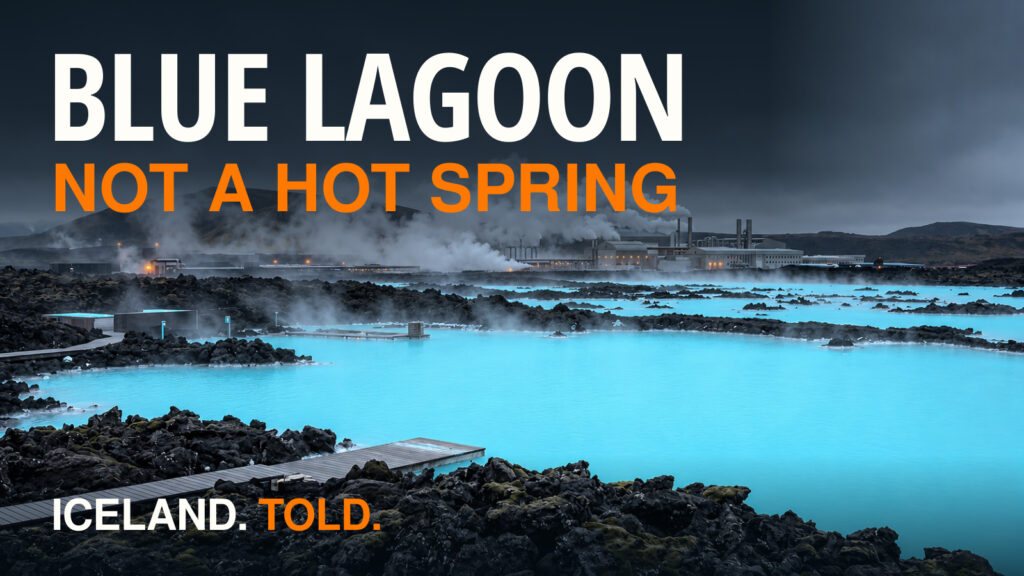
Absolutely not. While the Blue Lagoon (63.8804, -22.4495) uses cooled geothermal seawater regulated at a gentle 37–39°C, Gunnuhver (63.8190, -22.6852) is an untamed acid-sulfate mud cauldron boiling at ~100°C (212°F) at the surface above a >300°C (572°F) subterranean seawater reservoir (Visit Reykjanes; Iceland Travel). Stepping off the boardwalk onto the thin surrounding clay crust risks severe thermal and chemical burns.
Who was Gunna in the Gunnuhver ghost story?
Guðrún ("Gunna") Önundardóttir was an impoverished tenant living at Kirkjuból in Miðnes around the turn of the 18th century (Amazing Iceland). When she could not pay her rent, Law Council member Vilhjálmur Jónsson confiscated her only iron cooking pot. After starving to death in fury, her revenant (draugur) killed the landlord and terrorized the Reykjanes Peninsula until sorcerer-pastor Séra Eiríkur Magnússon of Vogsósar trapped her spirit by luring her to grab an enchanted ball of wool yarn (hnypill) that rolled straight into the boiling mud pit (Visit Reykjanes).
Why is Gunnuhver's deep reservoir seawater-fed?
Because Gunnuhver sits at the very tip of the Reykjanes Peninsula where the submarine Mid-Atlantic Ridge comes ashore, the pillow basalt and hyaloclastite bedrock is heavily fractured by tectonic rifting (~2 cm/year) (Visit Reykjanes: Geosites). Ocean water infiltrates directly into the porous volcanic crust, sinks two kilometers down to magmatic intrusions, and superheats above 300°C (logging up to ~320°C in the 2,054 m Borehole RN-10) before boiling; rising steam then condenses and mixes with shallow surface water (Stanford Geothermal Workshop).
Why did steaming at Gunnuhver intensify after 2006?
When HS Orka commissioned the neighboring 100 MWe Reykjanes Geothermal Power Plant (Reykjanesvirkjun) in May 2006, extracting ~800 kg/s of deep brine lowered reservoir pressure at 1,500 meters below sea level from ~120 bar-g to ~95 bar-g in the first year (pressure drawdown) (World Geothermal Congress 2010). That pressure drop promoted boiling at depth, expanded the underground steam cap between 800 and 1,200 meters (Geophysical Journal International), and invigorated surface steaming at Gunnuhver (Visit Reykjanes).
Related Iceland Explained Episodes
- Reykjanesviti, Valahnúkamöl & Eldey Island: Just across the road from Gunnuhver, where Iceland's oldest lighthouse location overlooks the storm boulders of "Volcano Man" and the sheer offshore stack where humans strangled the last pair of Great Auks in 1844.
- The Blue Lagoon (Bláa Lónið) & Svartsengi: Fifteen minutes east along the rift, where deep geothermal seawater was tamed through heat exchangers into a milky-blue silica basin inside the Svartsengi Resource Park.
- The Bridge Between Continents & Stampar (Rift Trinity): Walking across the tectonic graben fractures and 1210–1240 AD crater rows that frame the plumbing beneath Gunnuhver.