THE STORY
Contents
- The Blue Lagoon, Iceland: Eight Centuries of Lava, a Heating Crisis, and a Colony of Strange Microbes
- Quick Facts: The Blue Lagoon (Bláa Lónið) & Svartsengi Resource Park
- The Cold Radiators of Suðurnes and the Brine That Refused to Drain
- Inside the Resource Park: From Psoriasis Mud to Barley Greenhouses and Volcanic Methanol
- Carving the 1226 Lava: How Sigríður Sigþórsdóttir Staged the Blue Illusion
- When the Rift Took Back the Lease: Earthen Berms, Severed Pipes, and the Chemistry of Bathing
- Frequently Asked Questions (FAQ): The Blue Lagoon & Svartsengi
- Is the Blue Lagoon natural or man-made?
- Does every liter of water in the Blue Lagoon come straight out of a turbine?
- How did the 2023–2025 volcanic eruptions affect the Blue Lagoon?
- Why do you have to put conditioner in your hair and remove contact lenses before entering?
- Related Iceland Explained Episodes
The Blue Lagoon, Iceland: Eight Centuries of Lava, a Heating Crisis, and a Colony of Strange Microbes
Companion piece to the video episode: The Blue Lagoon (Bláa Lónið) & Svartsengi
On the afternoon of November 21, 2024, a slow, black-and-orange bulldozer of molten basalt crept across the asphalt of the Blue Lagoon (Bláa Lónið, 63.8804, -22.4495) main parking lot in Svartsengi and swallowed 350 car spaces whole (Iceland Review: Lava Engulfs Blue Lagoon Parking Lot).
Less than two hundred meters away, behind a ten-to-fifteen-meter-high rampart of bulldozed volcanic scoria and crushed rock (63.8840, -22.4250), the milky-cyan bathing basin and the stainless-steel turbine halls of the Svartsengi Geothermal Power Plant (63.8792, -22.4328) stood intact behind the barrier. Over the following days, crews used water cannons to cool lava threatening the defences and nearby infrastructure (Wikipedia: 2023–2025 Sundhnúkur Eruptions; Blue Lagoon: Volcanic Activity on the Reykjanes Peninsula). Look down at the stratigraphy beneath that parking lot and you witness a geological rhyme that took eight centuries to land: the fresh 2024 lava from the Sundhnúksgígar crater row was pouring directly on top of Illahraun (“Evil Lava”, 63.8825, -22.4550), the jagged tholeiitic apalhraun (ʻAʻā) flow that erupted during the medieval Reykjanes Fires in 1226 AD (World Geothermal Congress: History of the Blue Lagoon in Svartsengi).
Between the eruption of 1226 and the eruptions of 2023–2025, this sunken patch of broken rock north of Mount Þorbjörn (63.8617, -22.4333) became the laboratory where Icelandic engineers solved an impossible winter heating crisis, accidentally grouted a porous lava sieve shut with colloidal silica, and built the Svartsengi Resource Park (Auðlindagarðurinn): an industrial ecosystem where geothermal brine, volcanic carbon dioxide, patented microalgae, and architectural sleight of hand feed off the same two-kilometer-deep wound in the Mid-Atlantic Ridge (World Geothermal Congress: The Svartsengi Resource Park).
Quick Facts: The Blue Lagoon (Bláa Lónið) & Svartsengi Resource Park
| Attribute | Verified Field Data |
|---|---|
| Canonical Names | Bláa Lónið (/ˈplauːa ˈlouːnɪð/, “The Blue Lagoon”) | Svartsengi (“Black Meadow”) | Illahraun (“Evil Lava”) | Auðlindagarðurinn (“The Resource Park”) (World Geothermal Congress). |
| Coordinates & Elevation | Main Lagoon: 63.8804, -22.4495 (~20 m a.s.l.) | Svartsengi Power Plant: 63.8792, -22.4328 | 1981 Original Runoff Pond: 63.8788, -22.4375 | Mount Þorbjörn: 63.8617, -22.4333 (243 m). |
| Lava Stratigraphy | Seated in Illahraun (1226 AD Reykjaneseldar eruption); bordered by 2023–2025 Sundhnúksgígar basalt flows and 10–15 m protective earthen barriers (varnargarðar, 63.8840, -22.4250) (Blue Lagoon). |
| Hydro-Chemical Source | Geothermal seawater (jarðsjór) (~70% ocean water / ~30% meteoric rainwater) tapped at 1,400–2,000 m depth at ~240°C (464°F); bathing basin (~9 million liters, 37–39°C, 2.5–2.7% salinity) renews every ~40 hours without added chlorine (OSTI: Stanford Geothermal Program; Verkís). |
| Microbiology & Biotech | ~60% of sampled brine organisms reported novel at species level (World Geothermal Congress); includes Silicibacter lacuscaerulensis (1997) and Blue Lagoon microalgae (skincare extracts studied by Grether-Beck et al., 2008; patents US 8,795,679 B2 / EP 2026759 B1). |
| Resource Park Neighbors | HS Orka (heat & power), Carbon Recycling International (George Olah CO2-to-methanol plant, 2012), ORF Genetics (geothermal barley greenhouses), Matorka (aquaculture), and Blue Lagoon R&D / Clinic (HS Orka: Resource Park Partners). |
| Architectural Lineage | 1987 (first public sheds) | 1994 (Lækningalind Medical Clinic) | 1999 (modern lava-trench bathhouse by Sigríður Sigþórsdóttir, VA Arkitektar) | 2005 (Silica Hotel) | 2018 (The Retreat) (Basalt Architects). |
The Cold Radiators of Suðurnes and the Brine That Refused to Drain
To understand why anyone drilled into the middle of the Illahraun lava field in the first place, you have to remember an awkward historical disparity from the early 1970s: while families in Reykjavík were already heating their houses cheaply with clean, low-temperature freshwater geothermal wells, the wind-battered fishing towns of the Reykjanes Peninsula, Grindavík, Keflavík, Njarðvík, Sandgerði, Garður, and Vogar, were still paying through the nose for imported fuel oil (World Geothermal Congress). When the global OPEC oil crisis struck in 1973, heating a house on the peninsula became a municipal emergency.
The obstacle beneath Suðurnes was never a shortage of heat. Here on the oblique on-land segment of the Mid-Atlantic Ridge, where the North American and Eurasian plates pull apart at roughly two centimeters a year, magma sits close to the surface. The problem was that the young basalt pile is fractured all the way out to the ocean floor. Rainwater falling on Reykjanes never collects into surface rivers; it drops straight through the porous lava sponge to float as a thin freshwater lens atop intruding Atlantic seawater. Drill two kilometers down at Svartsengi (63.8792, -22.4328), and you do not hit potable hot water; you hit geothermal seawater (jarðsjór): a two-thirds ocean, one-third rainwater brine cooked by magmatic intrusions to roughly 235–240°C (464°F) and saturated with dissolved minerals leached from the basalt (OSTI: Stanford Geothermal Program; Perlan: History of Iceland’s Blue Lagoon).
Try pumping 240°C salty, mineral-heavy brine straight into town radiators and you will corrode the steel and choke the valves solid with silicate scale in a matter of weeks. At Svartsengi, engineers working for the regional heating utility (Hitaveita Suðurnesja, now HS Orka) began supplying heat in 1976 through a system that kept the deep brine and the municipal tap water in separate loops (World Geothermal Congress; Verkís: Svartsengi Geothermal Power Plant). Cold freshwater pumped from shallow aquifers was heated and degassed using steam flashed off the deep 240°C brine, while electricity generation followed in 1978.
Once the heat was extracted, the spent, cooled brine was piped out onto the rough, broken clinker of the 1226 AD Illahraun lava field. On paper, the disposal plan was elementary hydrology: since Reykjanes lava swallows every rainstorm without leaving a puddle, the discharged brine should have drained straight back down through the cooling cracks. Instead, thermodynamics ambushed the engineers. Two kilometers underground, at 240°C and high pressure, monomeric silicic acid stays completely dissolved in the fluid. Brought to the surface, depressurized, and cooled below 100°C, the brine becomes supersaturated with amorphous silica (SiO2) (World Geothermal Congress). The silica molecules polymerized into microscopic colloidal chains, flocculated in the 2.5% salt water, and settled into the lava pores as a dense, white gelatinous mud (kísilhræra) that grouted the basalt shut like porcelain cement (Perlan). Within months of the plant’s 1976 startup, a milky-blue lake had backed up across the sealed Illahraun depression right beside the cooling stacks.
Inside the Resource Park: From Psoriasis Mud to Barley Greenhouses and Volcanic Methanol
If the Blue Lagoon were merely the story of a clogged drainage basin that turned into a tourist pool, it would be a footnote in civil engineering. What makes Svartsengi fascinating is how locals, and later a team of geothermal engineers led by figures like Albert Albertsson, stopped treating the power plant’s outputs as waste and turned the surrounding lava field into the Svartsengi Resource Park (Auðlindagarðurinn), an industrial ecology where every exhaust stream feeds a neighboring enterprise (World Geothermal Congress: The Svartsengi Resource Park; HS Orka: Our Partners).
The human catalyst arrived before anyone had coined the phrase “Resource Park.” People suffering from psoriasis had begun experimenting with bathing in the warm, bluish pond beside the power station as early as 1978 (World Geothermal Congress), and in 1981 local aviation worker Valur Margeirsson secured formal permission from Hitaveita Suðurnesja to soak in the original runoff pool (63.8788, -22.4375) after conventional treatments failed to calm his severe plaque psoriasis (World Geothermal Congress; Perlan). When his scaling and inflammation subsided and word drew dozens of other patients over the sharp lava boulders, the utility opened basic public changing sheds in 1987, incorporated Bláa Lónið hf. in 1992, and established the dedicated Blue Lagoon Medical Clinic (Lækningalind, 63.8772, -22.4430) in 1994 to pair supervised brine baths with UV-B light therapy (World Geothermal Congress).
When microbiologists finally put the 38°C, silica-saturated brine under the microscope to find out what was living in the mud, they found an ecosystem that defied the old assumption that power-plant discharge must be biologically dead. Surveys reported in the World Geothermal Congress proceedings found that roughly 60% of the microorganisms living in the geothermal seawater brine were novel at the species level (World Geothermal Congress). In 1997, Icelandic researchers Pétursdóttir and Kristjánsson isolated and formally named a rod-shaped bacterium from the water, Silicibacter lacuscaerulensis (“silica bacterium of the blue lake”): a species first described from this exact warm saline habitat, though that initial isolation does not prove it exists nowhere else on Earth. Alongside it thrived specialized filamentous and coccoid Blue Lagoon microalgae, now cultivated year-round inside tubular photobioreactors at the company’s Harvesting Center in Svartsengi (World Geothermal Congress).
In 2008, a peer-reviewed dermatological study led by Susanne Grether-Beck tested bioactive extracts derived from that precipitated silica mud and microalgae on cultured human skin cells and in a clinical trial of twenty healthy volunteers (PubMed: Grether-Beck et al., 2008). The extracts upregulated key epidermal barrier proteins, including involucrin, filaggrin, and transglutaminase-1, inhibited UV-induced Matrix Metalloproteinase-1 (MMP-1) (an enzyme that breaks down dermal collagen), and measurably reduced transepidermal water loss in the human test group (PubMed). Those findings, now protected under international biotechnology patents including US 8,795,679 B2 and EP 2026759 B1, apply to concentrated extracts and formulated skincare products rather than proving that raw lagoon water alone cures psoriasis, yet they turned precipitated power-plant mud into a high-margin biotech export.
The same resource-park idea reaches beyond the lagoon, connecting enterprises that use different outputs from HS Orka’s geothermal operations (HS Orka: Our Partners; Ancala: HS Orka Case Study). At Svartsengi, Carbon Recycling International’s George Olah Renewable Methanol Plant was commissioned in 2012 as the first industrial-scale facility on Earth to capture waste carbon dioxide (CO2) vented from a geothermal power station and react it with hydrogen split from water via renewable electricity to produce 4,000 tonnes of liquid methanol fuel a year (Carbon Recycling International: George Olah Plant). Elsewhere in the wider Resource Park, ORF Genetics grows genetically engineered barley to produce growth factors, while Matorka raises Arctic char in land-based aquaculture (Ancala). The Blue Lagoon is not an isolated spa dropped beside a factory; it is the public-facing showroom of a wider network of geothermal businesses.
Carving the 1226 Lava: How Sigríður Sigþórsdóttir Staged the Blue Illusion
Why, then, do more than a million visitors a year step into the water convinced they have entered an untouched volcanic sanctuary? The credit belongs to a masterwork of Icelandic landscape architecture, and to a quirk of sub-micron optical physics.
For the first twelve years of public bathing (1987–1999), visitors soaked in the original pond (63.8788, -22.4375) directly beneath the roaring cooling stacks and pipe racks of the Svartsengi plant (World Geothermal Congress). There was no mistaking where you were. Then, in the late 1990s, architect Sigríður Sigþórsdóttir, founding partner of VA Arkitektar and later Basalt Architects, was commissioned to move the bathing experience several hundred meters west into a natural, moss-rimmed depression of the 1226 AD Illahraun flow (63.8804, -22.4495), opening the modern Blue Lagoon bathhouse in 1999, the award-winning Silica Hotel in 2005, and the subterranean luxury complex of The Retreat in 2018 (Basalt Architects: Blue Lagoon Silica Hotel; The Architect’s Newspaper).
Building inside an active geothermal lava field required solving problems no textbook covers. As Basalt Architects partner Marcos Zotes and his colleagues have noted of working in Icelandic geothermal ground, wherever you put a shovel down into the rock, steam cracks through, requiring foundations of specialized concrete and high-grade stainless steel to resist corrosive brine (The Architect’s Newspaper). Rather than bulldozing the Illahraun flat: a move that would have violated both aesthetic common sense and traditional Icelandic respect for the craggy lava mounds (hólar) associated in folklore with the Huldufólk (Hidden People): Sigþórsdóttir cut precise trenches into the 1226 AD basalt and pressed low, lava-coated concrete walls and white silica-rendered facades directly against the raw clinker (Basalt Architects). By sinking the water level below the surrounding lava ridges and angling the timber walkways away from the eastern pipe racks, the architecture edits the power plant out of the bather’s peripheral vision.
Once the industrial horizon is hidden behind black basalt walls, the Tyndall effect takes over the theater. Scoop a glass of water out of the lagoon and hold it up to the light: in your hand, the liquid is chalky white, not blue. Inside the 0.8-to-1.6-meter-deep basin, however, suspended colloidal silica particles scatter the shorter wavelengths of incoming daylight (blue and violet) back toward the surface far more strongly than longer red or yellow wavelengths (World Geothermal Congress). Because human eyes are much more sensitive to blue than violet, the brain registers a glowing, opalescent turquoise that shifts toward jade green when microalgae bloom under twenty-four-hour June daylight or collapses into a white fog labyrinth when freezing January air hits 38°C water. That visual contrast between black apalhraun and luminous cyan water is why cinema crews (from Eli Roth’s Hostel: Part II (2007) and Benedict Cumberbatch’s The Fifth Estate (2013) to the indie road movie Land Ho! (2014) and Star Trek: Discovery) repeatedly use Svartsengi whenever a script calls for deceptive luxury or an alien horizon.
When the Rift Took Back the Lease: Earthen Berms, Severed Pipes, and the Chemistry of Bathing
For nearly half a century after 1976, the bargain at Svartsengi looked permanent: the Mid-Atlantic Ridge supplied the 240°C brine, HS Orka’s heat exchangers supplied the controlled flows, and the 1226 AD Illahraun lava sat quietly as a passive black container.
Then, in late October 2023, satellite InSAR interferometry and GPS sensors detected rapid ground uplift centered barely 1.5 kilometers northwest of Mount Þorbjörn, right beneath Svartsengi (Wikipedia: 2023–2025 Sundhnúkur Eruptions). After eight centuries of dormancy, the Eldvörp–Svartsengi volcanic system had woken up. Between December 18, 2023 and August 2025, nine separate fissure eruptions tore open the Sundhnúksgígar crater row just two to three kilometers east of the lagoon (Blue Lagoon: Volcanic Activity).
What followed was one of the largest emergency earthmoving operations in volcanic history. Working round the clock with giant mining dump trucks and bulldozers designed by engineering firms including Verkís, civil-defense crews threw up a ring of ten-to-fifteen-meter-high protective earthen barriers (varnargarðar, 63.8840, -22.4250) encircling both the Svartsengi Power Plant and the Blue Lagoon (Wikipedia: 2023–2025 Sundhnúkur Eruptions). On the morning of February 8, 2024, the third eruption sent a 600-cubic-meter-per-second river of basalt across Grindavíkurvegur (Route 43) and sheared right through Svartsengi’s main hot-water supply pipeline, cutting off central heating across the Reykjanes Peninsula and leaving Keflavík Airport without its hot-water heating supply as communities across Suðurnes faced an interrupted service and engineers worked to restore the line (Wikipedia; Blue Lagoon). Nine months later, during the November 20, 2024 eruption, the molten front rolled four kilometers west, buried the 350-car parking lot outside the wall, and ground to a halt against the outer flank of the Svartsengi barrier while the lagoon and power station inside survived untouched (Iceland Review).
When you drive down the newly built gravel approach road inside those towering earthen walls today and step into the locker room, the lagoon’s strict house rules stop feeling like arbitrary spa etiquette and start making sense as physical chemistry (Blue Lagoon: Spa Etiquette). Because the roughly nine-million-liter bathing basin contains zero added chlorine, relying instead on regular microbiological monitoring, continuous water renewal every 40 hours, and a warm saline environment in which foreign human bacteria do not thrive, every visitor must strip completely naked and wash thoroughly with soap in the showers before putting on a swimsuit (Blue Lagoon: Spa Etiquette). Once you step outside into the 38°C brine, the same dissolved silica (SiO2) that cemented the 1226 AD lava shut will happily coat bare hair shafts and stiffen them into a dry, tangled straw broom unless you saturate your hair in leave-in conditioner beforehand and keep it tied up; the mineral-rich water will irritate your eyes if trapped behind contact lenses; and the trace hydrogen sulfide (H2S) gas rising in the steam will tarnish a sterling-silver chain black (Ag2S) before you finish your first lap around the silica mud buckets. Look up past the rim of the 1226 AD Illahraun trench toward the steaming black wall of the 2024 lava stopped just beyond the earthen berm, and you realize what you are actually soaking in: a human bargain with a rift whose last major chapter here began eight centuries ago, and which is still writing the contract.
A STORY. NOT A GUIDE.
ICELAND. TOLD.
Frequently Asked Questions (FAQ): The Blue Lagoon & Svartsengi
Is the Blue Lagoon natural or man-made?
The Blue Lagoon is a man-made (techno-natural) reservoir, though its water comes entirely from deep within the Earth (Perlan). It formed accidentally in 1976 when the neighboring Svartsengi Geothermal Power Plant discharged cooled geothermal seawater drawn from a ~240°C reservoir onto the porous 1226 AD Illahraun lava field, and precipitating silica (SiO2) cemented the lava cracks shut so the water pooled on the surface (World Geothermal Congress).
Does every liter of water in the Blue Lagoon come straight out of a turbine?
The lagoon originated in cooled discharge from Svartsengi’s heat-and-power operations, and today its bathing and medical facilities draw controlled flows of 37–39°C geothermal seawater from the same Svartsengi resource managed by HS Orka (Verkís). Inside the plant and supply system, the deep geothermal brine remains isolated from industrial oils or factory wash-water, and the ~9-million-liter bathing basin renews completely every 40 hours (Blue Lagoon: Spa Etiquette).
How did the 2023–2025 volcanic eruptions affect the Blue Lagoon?
Between December 2023 and August 2025, nine fissure eruptions occurred along the nearby Sundhnúksgígar crater row (Blue Lagoon: Volcanic Activity). Icelandic civil-defense engineers constructed massive 10-to-15-meter earthen protective barriers (varnargarðar) around Svartsengi and the Blue Lagoon (Wikipedia). While lava cut the old approach road in February 2024 and covered the exterior 350-car parking lot in November 2024, the barriers and water-cooling cannons successfully protected the lagoon, hotels, and power station, and a new parking area and road were built inside the defensive perimeter (Iceland Review).
Why do you have to put conditioner in your hair and remove contact lenses before entering?
The geothermal seawater is supersaturated with colloidal silica (SiO2). While beneficial to skin barrier function (PubMed: Grether-Beck et al., 2008), silica coats hair shafts and leaves hair stiff, dry, and tangled (“Lagoon Hair”) unless protected with leave-in conditioner beforehand. The operator also advises removing contact lenses because mineral-rich water splashed into the eye can cause irritation, and removing silver jewelry because trace hydrogen sulfide (H2S) tarnishes silver black (Blue Lagoon: Spa Etiquette).
Related Iceland Explained Episodes
- Grindavík & the Sundhnúkur Fires: Five kilometers south of Svartsengi: how a working fishing town confronted the 2023–2024 dike intrusions and built the defensive berms along the crater row.
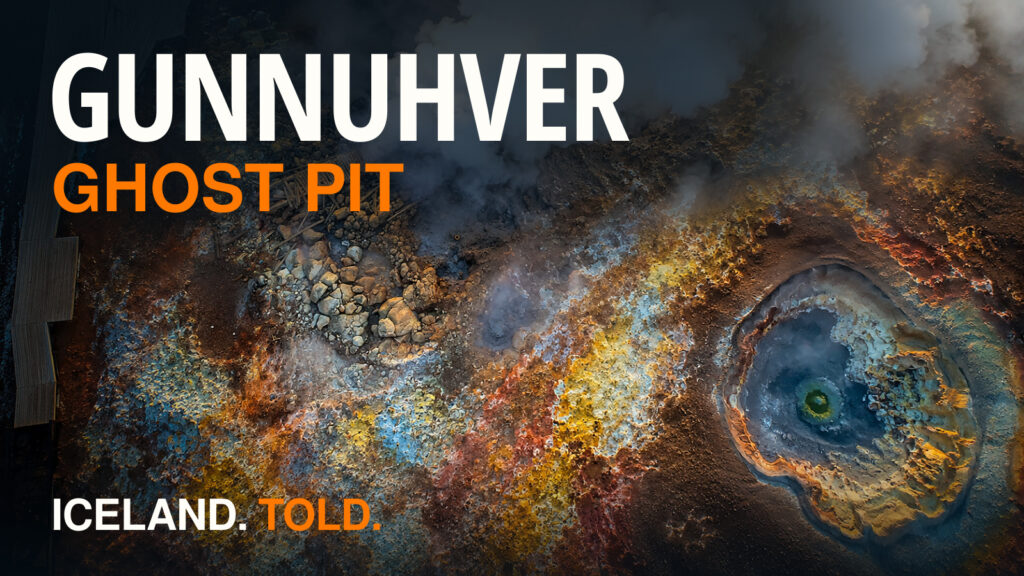
- Gunnuhver, Reykjanesviti & Brimketill: Fifteen minutes southwest down the rift, where the ghost Gunna’s boiling acid-clay cauldron (63.8190, -22.6852) shows what a >300°C seawater reservoir looks like without heat exchangers.
- Keflavík, Njarðvík, Hafnir & Ásbrú (Reykjanesbær): The northern municipalities whose cold 1970s radiators drove the original drilling at Svartsengi.