THE STORY
Contents
- Geysir & Strokkur, Iceland: The Glass Plumbing of Haukadalur, the Years We Fed a Volcano Soap, and the Troll Beside the Churchyard
- Laugarfjall’s Rhyolite, the Silica Plumbing, and the Living Glass Tomb
- The Sleeping Eve, Robert Bunsen’s Thermometer, and the Decades of the Soap Bucket
- Strokkur’s 1963 Drill, the Millisecond Blue Bubble, and the Spectacles of Blesi
- Royal Graffiti, the Troll Who Loved Church Bells, and the Downwind Trap
- Quick Facts: Haukadalur Geothermal Area (Geysir & Strokkur)
- Frequently Asked Questions (FAQ)
- Related Iceland Explained Episodes
Geysir & Strokkur, Iceland: The Glass Plumbing of Haukadalur, the Years We Fed a Volcano Soap, and the Troll Beside the Churchyard
Step across the wet wooden footbridge into the Haukadalur geothermal field, ninety kilometers northeast of Reykjavík on the Golden Circle, and the valley introduces itself at the back of your throat. Calling that sharp, stinging tang "rotten eggs" is too polite. It is hydrogen sulfide gas (H2S) leaking straight out of a geothermal basement deep beneath your boots: a warm, damp exhaust that clings to your hair, soaks into a wool sweater, and follows you back to the car like a stray dog.
To the hundreds of visitors crowded three-deep along the wet rope line with their phone screens raised, the valley looks like a natural water-park fountain running on a six-minute timer. Look down at the bleached, crunching rock under your heels, however, and you are standing on the roof of a self-sealing chemical engine. Nearly all of Iceland is built of dark basalt, yet true spouting geysers are among the rarest geological features on Earth. To understand why every geyser from Yellowstone to New Zealand took its name from a single hole in the ground here, and why twentieth-century Icelanders spent decades dumping buckets of laundry soap down its throat, you have to start with the pale mountain looming directly behind the steam.
Laugarfjall’s Rhyolite, the Silica Plumbing, and the Living Glass Tomb
Scan the hillside of 187-meter-high Laugarfjall at the western edge of the thermal field, and the rock is not charcoal-black basalt; it is pale, pinkish-grey rhyolite. That mountain, Laugarfjall, is part of the volcanic architecture behind the geysers.
There has been no surface volcanic eruption in the Haukadalur valley for ten thousand years. Instead, rainwater and snowmelt from the northern highlands percolate deep along fault fractures of the South Iceland Seismic Zone to absorb residual heat from a "fossil" furnace: cooling Pleistocene magmatic intrusions deep in the crust. Rock chemistry alone does not decide whether the water boils quietly or erupts: the heat supply, groundwater, and shape of the underground passages have to cooperate.
As hot water circulates through volcanic rock, including silica-rich rhyolite, it takes silica into solution as silicic acid (H4SiO4). When that boiling fluid rises and cools at the surface, the silica precipitates out of solution as Opal-A: amorphous, hydrated silica forming siliceous sinter or geyserite.
Every step you take along the Haukadalur paths crunches across that glass varnish. Near the boiling vents, it builds nodular "cauliflower" rims; across the flat runoff aprons, it lays down smooth, terraced sheets that seal the underground fractures into pressure-tight vertical pipes. Silica helps line the passages; their geometry helps hold the pressure; and when that balance breaks, the water erupts. Even more remarkably, studies of Geysir's discharge apron document silica preserving microbial structures as well as leaves and wood, turning parts of the pale rock into a microscopic necropolis, with traces of life sealed inside the mineral crust.
The Sleeping Eve, Robert Bunsen’s Thermometer, and the Decades of the Soap Bucket
Walk fifty meters north past the crowd gathered around the active spout, and you reach a surprisingly quiet, eighteen-meter-wide bowl of grey-white sinter filled with steaming turquoise water: The Great Geysir.
Coined from the Old Norse verb geysa ("to gush or rage forth") and first recorded as a proper name by Bishop Brynjólfur Sveinsson of Skálholt in 1647, this single vent is the nomenclatural Eve of every spouting hot spring on the planet. Mineralogical dating of its sinter mound indicates that Geysir began building its rim around 1150 AD, but its violent career has always run on seismic time. The Oddaverjaannáll chronicle records that in 1294, a series of violent earthquakes in South Iceland cracked open the valley's plumbing and gave birth to massive new spouting springs in Haukadalur.
When German chemist Robert Wilhelm Bunsen, inventor of the laboratory Bunsen burner, rode out to Haukadalur in 1846, the Great Geysir was a roaring giant. Measuring eruptions reaching forty-five to fifty-four meters into the sky, Bunsen lowered thermometers down its twenty-meter vertical shaft and solved the mystery that had baffled naturalists for centuries. He proved that the water at the bottom of the narrow conduit never reached a uniform boil all at once; instead, the sheer weight of the twenty-meter water column above acted like a heavy pot lid (hydrostatic pressure), raising the boiling point of the water at the bottom well above 100°C. Only when a rising bubble of steam pushed water over the top rim, suddenly taking the weight off the bottom of the column, did the superheated deep water flash instantaneously into steam, expanding 1,600 times in volume and blasting the entire column into the air.
After an earthquake in 1896, Geysir hurled water seventy to eighty meters high several times a day. Then its own glass chemistry caught up with it. As silica continued to coat its subterranean throat, helped along by nineteenth-century tourists who threw turf clods and boulders down the shaft to watch Geysir spit them back out, the pipe narrowed and the wide surface pool cooled enough to suppress boiling. By 1915–1916, the Great Geysir had gone to sleep.
Human pride refused to let the world's most famous geyser nap during a VIP visit. In 1935, the same year landowner Sigurður Jónasson donated Geysir to the Icelandic nation, engineers hacked a drainage channel through the precious silica rim to lower the water level in the bowl and reduce the hydrostatic weight on the shaft, reviving eruptions for a few years. When Geysir grew sluggish again in the 1940s through the 1970s, authorities resorted to chemical coercion: on National Day (June 17) or whenever foreign dignitaries and film crews arrived, guides dumped tens of kilograms of soft soap straight down the twenty-meter throat. Hrafn Gunnlaugsson's 1981 film involved another intervention: reopening and enlarging the old drainage channel. By lowering surface tension and changing how steam bubbles coalesced at depth, the soap forced an artificial flash-boil. The soaping practice ended in 1992, according to the local historical account, leaving Geysir to wait for its real master: on June 17 and 21, 2000, twin magnitude 6.5 earthquakes shook South Iceland and cleared the deep fractures, reviving Geysir's eruptions, with heights reported as high as 122 meters before it slowly drifted back into dormancy after 2016.
Strokkur’s 1963 Drill, the Millisecond Blue Bubble, and the Spectacles of Blesi
While the Great Geysir sleeps between earthquakes, all the daily labor falls to its neighbor fifty meters south: Strokkur, "The Churn."
First recorded after the great earthquake of 1789, Strokkur was silenced for over sixty years when the 1896 earthquake shifted its underground stones. It only returned to work in 1963, when the Geysir Committee brought in a drill rig and drilled a borehole to 39.4 meters to restore activity. Ever since, Strokkur typically fires every four to ten minutes with what looks like mechanical precision.
If you want to see what separates a field observer from the tour-bus crowd, do not look at the sky; look straight into Strokkur's roughly 2.2-meter-wide central opening ten seconds before it blows. Seismic studies place a subterranean "bubble trap" roughly twenty-four meters deep and thirteen to twenty-three meters west of the conduit: a reservoir where steam accumulates beside the shaft rather than a simple narrowing directly underneath it. As early steam bubbles rise into cooler water and collapse, they send a rhythmic cavitation hammer-blow through the ground: a low thump you feel in your breastbone before the water surface even twitches.
Then a massive slug of steam escapes the trap and shoves the water column upward. For a single fraction of a second before the eruption rips open, the surface tension of the cooler pool water holds fast. The entire pool bulges upward into a smooth, hemispherical dome of water that looks like liquid glass: the Blue Bubble.
Up on the terrace above Geysir, the twin pools of Blesi sit side by side like a pair of spectacles: one hot source pool crystal-clear, the cooler runoff pool glowing milky turquoise as suspended silica scatters the light. Strokkur offers a different blue spectacle: a curved, translucent water dome catching the sky before it bursts. The family resemblance is blue; the two spectacles need not share a single optical recipe. A split-second later, surface tension loses the fight: THUMP. The membrane shatters, the unloaded water column flashes to steam, and a twenty-to-thirty-meter white jet tears into the wind.
Royal Graffiti, the Troll Who Loved Church Bells, and the Downwind Trap
Walk up the sinter slope past Blesi toward the foot of Laugarfjall, and you find the marks left by people, and monsters, who tried to claim a piece of this heat. Beside the upper path sit the boulders of Konungasteinar, carved with the crowned royal monograms of three successive Kings of Denmark who rode out to inspect their unruly northern dependency: Christian IX in 1874, Frederik VIII in 1907, and Christian X in 1921. Right nearby boils Konungshver ("The King's Hot Spring"), a wide cauldron that appeared after the 1896 earthquake and has spent the century since quietly mocking royal permanence by shifting erratically between clear blue and murky rust-red.
Eight hundred meters north of the steaming vents, beside the churchyard of Haukadalskirkja, lies a much older resident. According to local folklore, a gentle, prophetic mountain troll named Bergþór lived in a high cave on Mount Bláfell with his wife Hrefna. Unlike the violent trolls of the highland passes, Bergþór was on good terms with his Christian neighbors and loved listening to the distant chime of the Haukadalur church bells. As he grew old, he asked the farmer of Haukadalur to give him a resting place where he could hear both the bells and the river, promising that when he died, his giant iron-shod walking staff (broddstafur) would appear propped against the farmhouse door. One morning the giant staff was waiting on the threshold; the farmer kept his word, hauling Bergþór down from the mountain and burying him north of the churchyard, where a heavy stone still marks the troll's grave today.
Back on the sinter flats around Strokkur and Litli Geysir, the heat paints its own warning system across the runoff channels. Orange streamers and emerald mats spread across cooler runoff while hotter surfaces can remain stark white. Microbial pigments respond to heat, light, and water chemistry; they paint a living mosaic rather than a calibrated thermometer. Beyond the scalding water, the struggle for ground continues: invasive Southern Hemisphere star-moss (Campylopus introflexus) is a concern in Icelandic geothermal habitats.
Leave that living mosaic undisturbed, and check the wind vector before you pick your spot at the rope line. The low rope around Strokkur is a psychological boundary, not a shield: when a sudden gust catches a collapsing twenty-five-meter water column, eighty-to-ninety-degree alkaline water (pH 8–9) sticky with dissolved silica turns into a horizontal weapon, scalding anyone standing downwind (as two children on the viewing path discovered in 2015), while stepping off marked paths near boiling pools risks breaking through thin crust into scalding water or mud. Kúalaug ("Cow Pool"), near the church and forest, is a separate warm pool, not one of these boiling vents. And if downwind mist from Strokkur lands on your camera lens or eyeglasses, never wipe it dry: as the droplets evaporate, mineral residue can dry onto the glass, and rubbing grit across an optical coating can scratch it. Loosen the residue with clean water or a suitable lens cleaner before wiping.
Come back to Haukadalur at two in the morning in June, when the tour buses have vanished from the car park, the lingering subarctic twilight glimmers off the wet white geyserite, and Strokkur thumps and exhales into an empty valley. The neon-blue bubble swells for its single split-second against the horizon, shatters into steam, and leaves that sharp, ancient tang of hydrogen sulfide clinging to the wool of your coat all the way up the road to Gullfoss.
A STORY. NOT A GUIDE.
ICELAND. TOLD.
Quick Facts: Haukadalur Geothermal Area (Geysir & Strokkur)
| Feature / Attribute | Verified Field Detail |
|---|---|
| Location & Protection | Haukadalur valley, Bláskógabyggð, South Iceland (64.3104, -20.3024); ~90–100 km NE of Reykjavík on the Golden Circle. Protected as a 1.2 km² Natural Monument on June 17, 2020 (364 mapped thermal spots). |
| The Lithic Secret | Volcanic terrain including Laugarfjall's rhyolite supplies silica to geothermal water; cooling and evaporation deposit Opal-A siliceous sinter (geyserite), while conduit geometry helps control eruptions. |
| The Great Geysir | Nomenclatural origin of the word geyser (from Old Norse geysa, recorded 1647; active since the 1294 earthquakes). Measured at 45–54 m by Robert Bunsen (1846), 70–80 m (1896), and heights reported up to 122 m following the June 2000 quakes; revived by a rim ditch in 1935 and soap until banned; dormant since 2016. |
| Strokkur ("The Churn") | Located 50 m south of Geysir; born in the 1789 quake, blocked in 1896, and re-drilled open in 1963. Erupts every 4–10 minutes to 15–30 m (up to 40 m) via a bubble reservoir inferred at ~24 m depth and offset west of the conduit, preceded by a fleeting Blue Bubble. |
| Supporting Vents & Lore | Blesi: Twin clear (~90°C) and colloidal opal-blue (~40°C) pools. Konungshver & Konungasteinar: Royal monograms of Danish Kings (1874, 1907, 1921). Haukadalskirkja: Grave of the friendly mountain troll Bergþór. |
| Field & Gear Hazards | Always stand upwind of Strokkur (wind shifts drive scalding 80–95°C alkaline water across the downwind path); loosen dried spray residue before cleaning camera lenses; stay strictly on marked paths away from fragile crusts and boiling vents. |
Frequently Asked Questions (FAQ)
Does the original Great Geysir still erupt when you visit Haukadalur?
Rarely. The Great Geysir, which gave English the word geyser, runs on earthquake cycles and has been mostly dormant since 2016 (after a brief, violent revival following the June 2000 South Iceland earthquakes). The geyser that visitors watch erupting every 4 to 10 minutes to heights of 15 to 30 meters is its neighbor Strokkur ("The Churn"), located 50 meters to the south.
Why did guides used to pour soap into the Great Geysir, and why is it banned now?
When silica deposition and cooling surface water caused the Great Geysir to fall dormant in the twentieth century, authorities and guides periodically dumped tens of kilograms of soft soap into its 20-meter shaft on National Day (June 17) or for visiting dignitaries and film crews. Soap alters surface tension and bubble coalescence at depth, helping trigger an eruption. The practice was discontinued in 1992 according to the local historical account; adding substances to protected geothermal features is not an acceptable visitor activity.
Why does Strokkur form a glowing blue bubble right before it explodes?
Rising steam pushes the water column into a transient dome before it bursts into a jet. Seismic work places a feeding bubble reservoir at roughly 24 meters depth, offset west of the conduit. The curved dome appears blue, but the cited studies do not establish that its colour has the same colloidal-silica mechanism as Blesi.
How do you protect camera lenses and glasses from Geysir and Strokkur spray?
Water spray can leave mineral residue on glass. Avoid rubbing a dry, gritty surface: loosen deposits with clean water or a suitable optical cleaner, then clean according to the equipment manufacturer's instructions. A clear protective filter can help protect a camera lens.
Related Iceland Explained Episodes
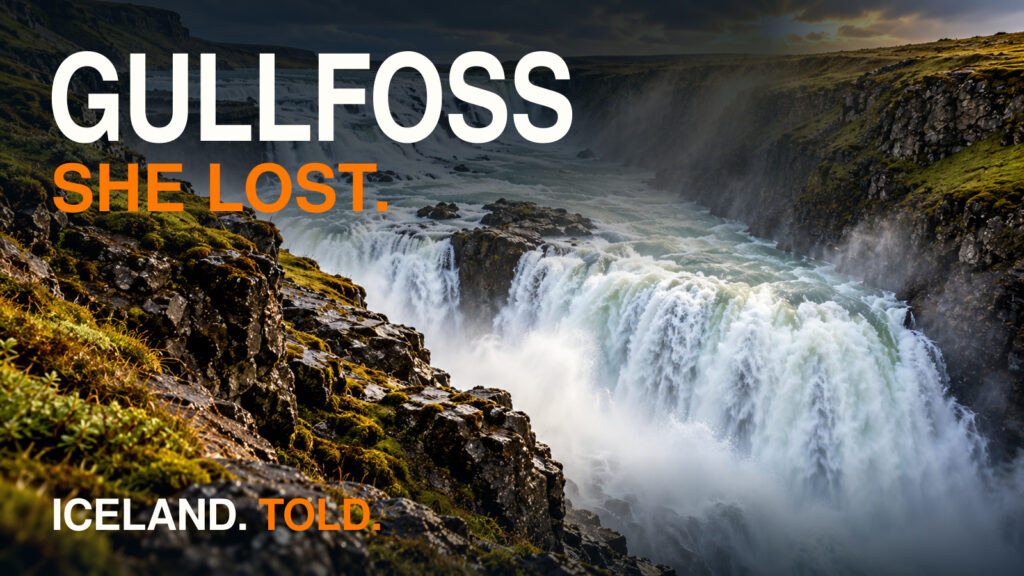
- Gullfoss Waterfall, Iceland | Brown Noise & Kinetic Silence: Follow the 1907 King's Road nine kilometers east of Haukadalur to see how the glacial river Hvítá cuts into its layered volcanic canyon.
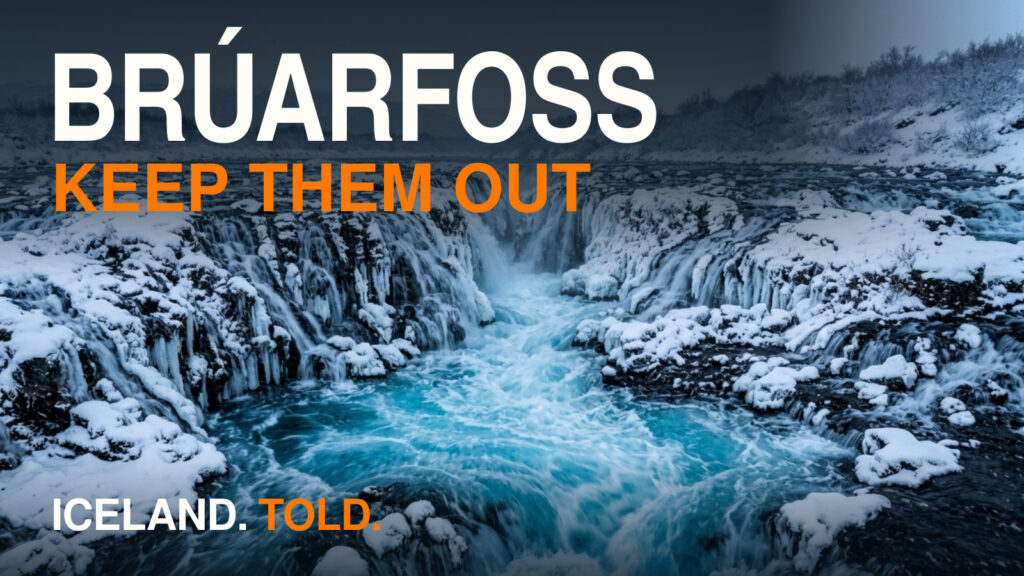
- Brúarfoss, Iceland | The Blue Fissure Waterfall: Drive fourteen kilometers southwest from Geysir for another encounter with intensely blue water in a cold spring-fed river.
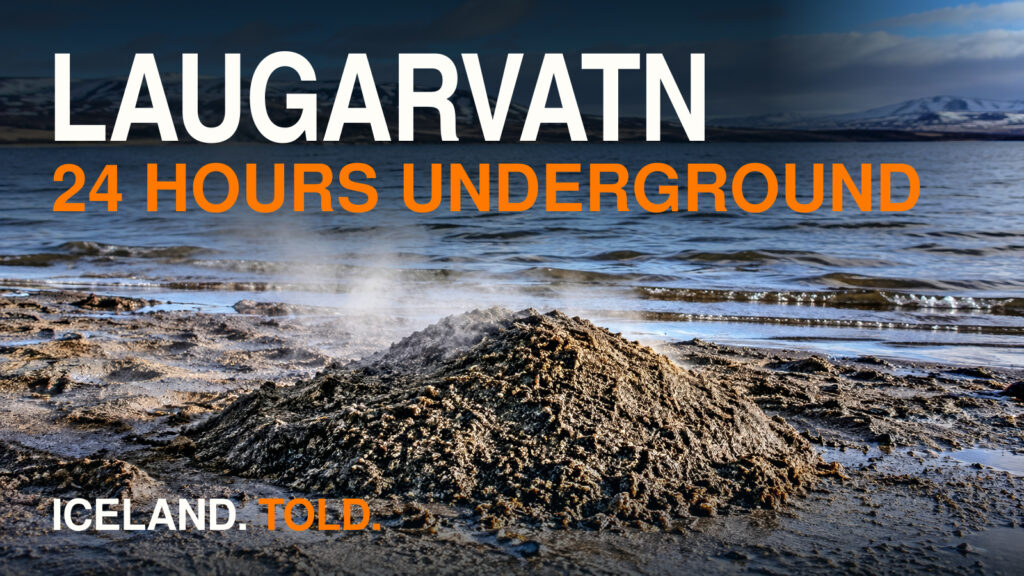
- Laugarvatn, Iceland | Hot Sand, Móberg, and Geothermal Bread (coming later): Continue west along Route 37 to the boiling lakeshore sand where Icelanders bake dark rye bread underground for 24 hours.